
13 Things To Know About Visiting Antelope Canyon

Upper and Lower Antelope Canyons are famous, wave-like canyons in Northern Arizona, which have been carved out over millions of years by flash floods and wind.
Slot canyons occur around the world and are a much-loved phenomenon, but these are particularly beautiful, even compared to others. In fact, most would agree these are among the most famous slot canyons in the world, this is thanks to their unique, smooth shape formed within Navajo sandstone.
Planning a trip to see these stunning canyons? There are a few things to be aware of before you go, below is everything to know about visiting Antelope Canyon.

Important Things To Know About Visiting Antelope Canyon
Antelope Canyon Can Close Due To Weather
I admit weather is not the most exciting topic to start off with, but it’s the area’s unique weather and landscape which created these incredible slot canyons, and the weather can impact your visit.
While it’s not common, the canyons do close due to weather. Storm water drains through the Antelope Canyon system, eventually emptying into the Colorado River, creating potentially deadly flash floods. For obvious safety reasons, the canyons close when there’s flood risk.
Since Upper and Lower Antelope Canyon are (almost) connected, if there’s risk of flood in one, there will be in the other as well.
Closures are most common during monsoon season, which is typically July – September.
Antelope Canyon Weather
The landscape surrounding the canyons is desolate with few trees, meaning there’s little shade. There’s also very little rain, Page only averages about 6 – 7 inches of annual precipitation.
When rain does come, it’s in the form of monsoons. This means storms are brief but intense, and since the dry, desert floor can’t immediately absorb rain, the result is often flash floods. Monsoon season is July – September.
Summer highs reach the upper 90°F’s with lows into the 60°F’s and 70°F’s.
Winter highs reach the mid 40°F’s and see lows in the low 30°F’s.
Spring and fall are both mild averaging highs in the 60°F’s and 70°F’s with lows in the 50°F’s and 40°F’s.
The canyon sees little sun and will be significantly cooler than the outside temperature.

The Canyons Aren’t Directly Connected
Upper and Lower Canyon are part of the same wash system, but aren’t immediately connected.
The slot canyons are about 7.5 miles apart.
Upper vs Lower Antelope Canyon
The canyons are very similar but there are a few characteristics separating the two.
First, Upper Antelope Canyon is wide at the base and narrow at top, like an “A”. The opposite is true for Lower Antelope Canyon, it’s narrow along the footpath, with a wide opening over top, like a “V”.
Second, the Upper Canyon has taller, more dramatic canyon walls with varying colors, and accessing Upper Antelope Canyon does not require any ladders.
Third, Lower Antelope Canyon is set into the ground, you must use ladders to access it. The walls are not as tall and are very orange in color.
You May Also Like: Upper vs Lower Antelope Canyon: Which Is Best For You?


Antelope Canyon X
Antelope Canyon X is located at the very southern end of the Antelope Canyon wash. Again, neither Upper, Lower, or Canyon X are technically connected but the same water runs through all three.
Canyon X is very similar to Upper and Lower, while it’s not quite as dramatic, it’s still an amazing landscape. Since it’s a lesser known alternative, Canyon X is less expensive and easier to book, which you can do so here: Antelope Canyon X Guided Tour.
When Is The Best Time To Visit Antelope Canyon?
Timing is important when visiting Antelope Canyon.
Upper Antelope Canyon is best between 11 am – 1:30 pm. I don’t advise visiting outside this time slot. The canyon gets very dark outside these hours, it becomes hard to see the details and difficult to photograph.
Lower Antelope Canyon is best roughly 10 am – 12:30 pm. However, the canyon is still very beautiful outside these hours. I wouldn’t stress about booking Lower during an exact time frame. We toured Lower Antelope Canyon in the late afternoon, around 2:30 and still had great lighting.
Summer is the best time of year to see the canyons, due to light beams, which we’ll get into below. However, winter is great if you wish to visit with less crowds.

Antelope Canyon Light Beams
The light beams are a large part of what’s made Antelope Canyon so famous.
They create a whole moody, ethereal vibe. Someone even sold one of their beam photos for a whopping 6.5 million dollars.
Those who wish to see the captivating light beams, there’s a few important things to know:
- The light beams are only visible in Upper Antelope Canyon. You cannot see any in Lower Antelope Canyon.
- Light beams only occur during summer months, roughly April – September. They are best within 30 days of the summer solstice. If you visit in winter, you will not see light beams.
- 11 am – 1:30 pm is the window of time in which you can see the light beams. Noon is your best chance.
- The light beams are not visible when it’s cloudy.

Antelope Canyon Guided Tours
You cannot visit Upper or Lower Antelope Canyon without a tour guide, the slot canyons are located on private land.
Upper Antelope Canyon Needs To Be Booked Well In Advance
Thanks to the combination of high popularity and low availability, Upper Antelope Canyon tours book out very far in advance.
If you wish to see Upper Antelope Canyon in the high season (summer) you need to book your time slot months in advance.
For my winter visit I booked 30 days in advance (the earliest possible) to ensure we’d be in the canyon at the best time.
We booked our Upper Antelope Canyon Tour through Antelope Canyon Navajo Tours. Our fantastic guide, Leo, provided us with a ton of information about the area’s history, Navajo Nation’s history, the geology of the canyon… in addition to helping with photos!
We really enjoyed our Antelope Canyon Navajo Tours, I would recommend booking through them.

Lower Antelope Canyon Tours
Lower Antelope Canyon does not book as far in advance. If visiting in summer, I’d book a few weeks out.
During our winter visit we walked up 20 minutes before the tour time and were able to book with no problem.
I booked Lower Antelope Canyon with Dixie’s Lower Antelope Canyon Tour Company. Our guide, Cody, provided us with a ton of information about Navajo Nation’s history here and their relationship with the canyon today.
I would also recommend booking through Dixie’s Lower Antelope Canyon Tour.

Have Your Camera Ready Before The Tour Begins
Be sure to have plenty of photo storage and battery life on your camera or phone – trust me, you’re going to take more photos than you think.
Antelope Canyon Photography Tips For iPhone
The canyons, particularly Upper, can be difficult to shoot. Here are a few tips we received from our guides in regards to iPhone photography in Antelope Canyon:
- Shoot photos on iPhone’s Vivid Warm camera setting. This captures the color of the canyon with considerably more accuracy.
- Do not use flash.
- Do not shoot into the sunlight, make sure you are taking photos from a shaded portion of the canyon.
- Have fun and play around with the different angles.

What Should You Wear For Antelope Canyon?
When visiting Antelope Canyon you are permitted to bring cell phones, cameras, and water. Do not forget your water.
Don’t bring backpacks, fanny packs, purses, tripods, selfie sticks, or food — they are prohibited.
Proper Footwear
First and foremost, you’ll want a pair of closed-toe, sturdy shoes. You’ll be walking through red sand for the entirety of the canyon.
If touring Lower Antelope Canyon, you will be climbing ladders and navigating very narrow canyons, proper shoes are especially important here.
Tip: Wear shoes you don’t care to get dirty in the red sand. I wore my hiking boots.
Dress In Layers
You will experience varying temperatures while touring, layers are the best way to go. While getting to the canyons you’ll be exposed to heat and sun, there is no shade. Once in the canyon, temperature drops considerably.
Note: When driving to the canyon — necessary when visiting Upper & Canyon X, Lower Antelope Canyon is a short hike instead — you’ll be in an open air truck on dirt roads with lots of dust. Bring something to protect your eyes and face, if sensitive.
If it’s a particularly windy day, bring a hat and layers to protect yourself from blowing sand.
Last, be sure to apply sunscreen before heading out on the guided tour.
What I Wore To Antelope Canyon
I visited Antelope Canyon in February. I toured Upper Antelope Canyon at noon and Lower Antelope Canyon around 2:30 pm. It was mild weather in the 50°F’s, mostly sunny, however, there was wind and light rain during our Lower Antelope Canyon tour.
It was cooler in Upper Antelope Canyon than outside.
In Lower Antelope Canyon it felt warmer than outside because we were protected from the wind, this isn’t always the case.
Below is what I wore during the tour:
- Athletic leggings
- Breathable athletic jacket
- Lightweight winter jacket for outer layer
- Hiking boots with wool socks
- Ball cap (recommended by tour company for dust)
- Water bottle
I also visited with my grandparents — they did Upper Antelope Canyon only. Both wore jeans, hiking boots, and a hat. My grandpa wore a long-sleeve flannel and my grandma a lightweight winter jacket.
Bring Cash For Tipping
Last, please don’t forget to bring cash for a tip. Some guides do this on a voluntary basis and do not get paid.

Be Respectful: The Canyons Are Sacred To The Navajo People
The Navajo refer to these canyon’s as Tse’bighanilini, which means “The place where water runs through rocks.”
These canyons are spiritual and sacred to the culture and way of life of the Navajo Tribe. They are a symbol of the, “gifts of Mother Nature, the passage of time, and the fact that there are things larger and greater than themselves.”
Be respectful of their rules and requests. It is a privilege to witness these magnificent canyons.

Things To Do Near Antelope Canyon
There is so much more to do in Page, AZ than just visiting Antelope Canyon!
While you’re here be sure to explore the surrounding area:
- Tour the Glen Canyon Dam
- Eat delicious Mexican food
- Kayak Lake Powell
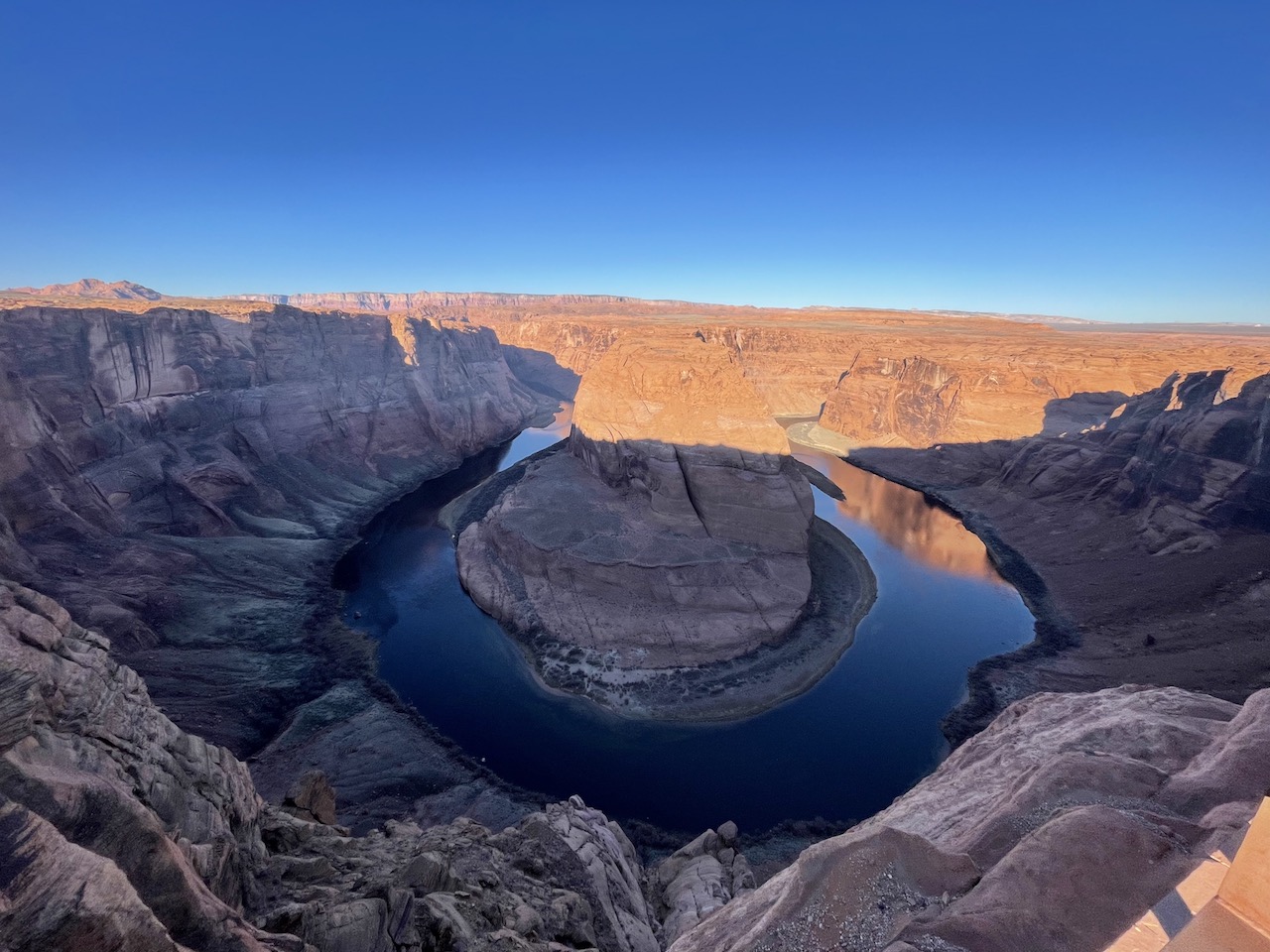
- Visit Horseshoe Bend Overlook
- Hike Hanging Gardens or Potato Hill Overlook
- Explore the Glen Canyon National Recreation Area
- Rent a house boat on Lake Powell
- Hike in Vermilion Cliffs National Monument
You May Also Like: Everything To Know About Visiting Horseshoe Bend
Where Is Antelope Canyon?
The canyons are on Navajo Indian Reservation land in a remote part of Northern Arizona, near the city of Page.
Popular Cities & Parks Near(ish) To Antelope Canyon
- Page, AZ – 7 minutes (4 miles)
- Kanab, UT – 1 hour, 20 minutes (78 miles)
- Zion National Park, UT – 1 hour, 50 minutes (110 miles)
- Monument Valley, AZ – 2 hours (120 miles)
- Flagstaff, AZ – 2 hours, 15 minutes (130 miles)
- Grand Canyon National Park South Rim, AZ – 2 hours, 25 minutes (131 miles)
- St. George, UT – 2 hours, 45 minutes (158 miles)
- Sedona, AZ – 3 hours, 10 minutes (160 miles)
- Phoenix, AZ – 4 hours, 20 minutes (273 miles)
- Las Vegas, NV – 4 hours, 30 minutes (276 miles)

These famous slot canyons are some of the most beautiful in the world and I enjoyed visiting them so much! I hope you’ve found these tips for visiting Antelope Canyon helpful in planning your trip.
Looking for more ideas? Check out my additional Arizona and US Southwest guides below or head on over to Visit Arizona!
More Information For Your Trip To Page, Arizona:
- Upper vs Lower Antelope Canyon: Which Should You Choose?
- Horseshoe Bend: Things You Must Know Before Visiting
- Page, AZ: 3-Day Weekend Itinerary
- Top Hotels In Page, Arizona
More Information For Your Northern Arizona Vacation:

Pin for later!



Keep Up With Amy!
Subscribe to the newsletter for the latest updates in your inbox. And don’t forget to connect on your favorite social platform!
Thank you!
You have successfully joined our subscriber list.